Sisters of the Burning Branch Goddess Gallery
Presents...
Chamunda Maa
Final Project Level 1
Chamunda Maa
Chamunda Devi is a Goddess traditionally found in India, Nepal and Asian cultures. She has a myriad of various stories, sacred symbolism and meanings behind her iconography. Chamunda is a Shakta Tantric Goddess, one of the 64 Yoginis and one of the 8 Matrikas, a fierce warrioress and Ultimate Divine Cosmic Creatrix, and aspect of KaliMaa.
Multiple stories can be found featuring variations of Chamunda; from the Devi Mahatmya, Mahabharata, Haravijaya, Devi Bhagavata, and a myriad of Puranic texts (Vayu, Skanda, Vamana, Marsha, Siva, Kalika, Varahu, etc).
Myth:
Iconography
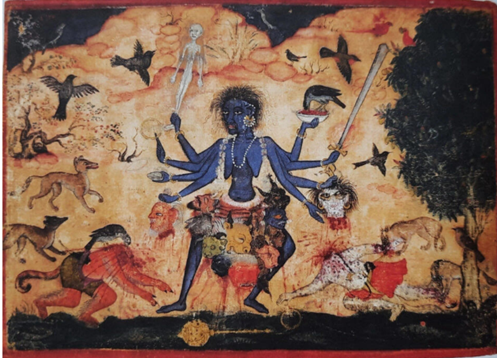
In each text, Chamunda descriptions and iconography varies: from having 2 arms, 4, 8, 16, 18, 22 or more, to being seated on a corpse, Buffalo, owl, jackal or even a crow, sometimes with the owls and jackals can be seen eating the corpse.
What ChamundaMaa holds in her hands also varies: from a skull topped staff, decapitated heads, kartri , varada, carcika/trident, bell, noose, rosary, damaru, kapala, sword, naga (snake), abhaya , shield, etc… On some occasions she is even depicted with snakes coming out of her hair in a very Medusa-like fashion.
Either way, no matter which text is told, the physical appearance of Chamunda Maa is relatively the same: she is an emaciated, ferocious crone: to the point you can see her skeleton, veins, ribcage and bones, hollowed out stomach, fangs, breasts are sagging from untiring her children, eyes are sunken in and glowing red.
Her hair is piled on top of her head, frequently seen with crescent moon hairpiece and sometimes a crown of flames and always a necklace of skulls.

Other associations
Home: cremation grounds
Flower: hibiscus
Color: Red
Direction: Northwest
Group affiliations: Matrikas & One of the 64 Yoginis
Consort: none
Face makeup: ashes from funeral pyres
Attributes: Goddess of war, fierce protector & destroyer, ultimate protector of her children & devotees.
Season: autumn (due to this being the time of animal sacrifice)
Offerings: animal sacrifice
Drink: wine
Tree: fig
Skin color: black, dark smoke/blue , or red
Temples are generally in the mountains and near a cremation ground.
Chamunda has influenced art in temple paintings, stone sculptures, and homes throughout India and Nepal.
Festivals associated with Chamunda
· Navratri: During the nine-day festival of Navratri, the eighth day (Durga Ashtami), prayers to invoke blessings for strength, protection, and success.
· Dussehra: festival that marks the triumph of good over evil,”paralleling the goddess’s own victories over demons like Chand, Mund, etc...”
“An auspicious day would be Shukla Paksha Ashtami Tithi – the eighth day during the light or waxing phase of the moon. Another favourable day would be Shukla Paksha Chaturdasi Tithi – the fourteenth day during the light or waxing phase of the moon. “
;
However, according to Chamundesvari Temple In Mysore, the Kanna Kannadi festival is of utmost importance and held on the first Tuesday after the full moon day, in Aug/Sept.
Mantra
Om Aim Hrim Klim Chamundayai Vichche
ChamundaMaa
Ritual
Needed
Incense Moon water (eclipse)
Red hibiscus Candles: 2 red, 1 black/1 white
Lava Rock Bell
Wine Rum
Blue Lagoon water Owl feather
Charcoal Copal
Camphor Carnation
Mint Jasmine
Jewelweed Coltsfoot
Thyme Sacrificial animal : black rooster (or black rooster feather )
Red tassel optional Rice
Ritual
(Arrange alter placing lava rock in center )
Light white candle
Light incense
Cleanse with moon water
Purify with incense
Ring bell
Cast circle & call in the quarters
While ringing bell, light another incense and circle it around altar and devotionals
Ring bell and light 2 red and black candle
While ringing, circle black candle around altar 3 times
Ringing bell, circle moon water chalice 3xs around altar
Ringing bell, circle flower around altar 3xs , offer it to Chamunda .
Prepare burning offering dish ….
Charcoal in fire safe container
Offer
Thyme : purify
Camphor : clarity
Coltsfoot (substitute for tobacco) , visions
Rice: around charcoal
Copal: purification
Waft smoke over lava rock with owl feather
Say Mantra 108 times
Apply Jewelweed to self.
Add rum on rice: set on fire
Add thyme sticks, mint (healing & protection),
jasmine (love, devotional)
& carnation (protection, healing, strength)
Offer black sacrificial feather into fire
Add candle wax to fire if need to burn all.
As fire burns, do self blessing with moon water,
Close quarters, close circle
Drink the wine.
Chamunda, above all else, is predominantly a war Goddess, the ultimate Protectress of her Devotees. She IS the most fierce destroyer and also the ultimate cosmic Creatrix: the ultimate Devine feminine source.
REFERENCES
This page is the intellectual and creative property of Puspa.
Samhain 2025
All Rights Reserved
GoddessSchool
Visit
Our Goddess Gallery!