And
choose TWO or
THREE
of the followingElective Texts for Level III.
These books will give you much needed information and
experience on the
different paths
and areas that are available, choose books that resonate with the path
that you would like to follow.
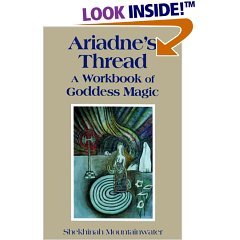
Ariadne's Thread: A
Workbook of Goddess
Magick By
Shekinah Mountainwater
Goddess Studies (I*, II, III)
Creating Sacred Space (I*, II,
III)
Making Ritual (I*, II, III)
Meditation (I, II*, III)
Energy Work (I, II*, III)
Divination (II*, III)
Dream Work (II, III*)
Astral Work (II, III*)
Healing (II, III*)
Ordinary Magick (II, III*)
High Priestess (IV)
I = Level I
II = Level II
III = Level III
IV = Level IV
* denotes a strong emphasis
Book showing
methods by which you can positively
change your life and bring into being the things you dream of. Create
your own reality by understanding the laws of life.
A complete
step by step guide on making your own
Bamboo flutes. All the ins and outs. Suitable for the beginner flute
maker as well as the advanced. Models covered include the Shakuhachi,
Side Blown, Native American Flute, Bamboo Sax and Recorder.
The Pentacle is
a magickal
symbol consisting of a pentagram - a
five-pointed star -- pointing upward and enclosed by a circle.
Worshipped by the ancients, its meaning is "life" or "health". It is
worn as a symbol of a Witch's belief and used in magickal workings and
ceremonies. Each point on the star relates to the five magickal
Elements - Earth, Air, Fire, Water, and Spirit.
The pentacle,
or pentagram, is the most revered and most popular sign of the craft.
It
is similar to the Cross or Crucifix of the Christian religions. This
symbol
has nothing to do with the devil or with evil. Devil worshippers use
this
symbol inverted as a symbol of Satan, but it has nothing to do with the
devil
in our religion. Devil worshippers use this symbol because it was once
a
popular Christian symbol used to signify the five wounds of Christ. It
was
abandoned early in history but can still be found in much of the art
and
architecture of old churches and monasteries. This, for its protection
and
Christian meaning, was the symbol carried on Sir Gawain's shield.
In
witchcraft the pentagram
and pentacle represent the five elements
and are symbols not only of the religion, but also as a sigil of
protection
and unification. The elements are Earth, Air, Fire, Water, and Spirit.
This
is not to be confused with the Holy Spirit of the Christian religion.
The
spirit is the energy vibration attributed to each and every thing.
People
have them as well as animals, stones, trees, planets, moons, stars,
even
the universe. It is often used for protection and is included on most
amulets
and talismans. It can be drawn in certain ways to promote specific
results
in spell work.
The
banishing (getting rid of
something - i.e.: negativity, evil, etc.)
pentagram is drawn starting at the bottom left-hand point going up to
the top, down to the bottom right-hand corner and so on. This pentacle
is drawn this way in all rituals involving banishing. It is also drawn
over doors and
windows to prevent evil from entering a space.
The
invoking (bringing
something toward you - i.e.: money, luck, etc.)
pentagram is drawn starting at the top corner, down to the bottom left
hand
corner, up to the top right hand corner and so on. The invoking
pentacle
is drawn in this way when you want to draw something toward you or to
gain
something. This pentacle heightens power and aids in invocative spell
work. The pentacle is also representative
of the five points on the human
body. The circle is considered feminine and is indicative of the womb
and the
points represent the male member. Sometimes the inverted pentacle is
used
to signify the God and the upright pentacle is used to represent the
goddess.
This method is not often used, however, as it has very evil
connotations
in other religions. In many other pagan religions, the pentacle was the
symbol of the earth or the earth-womb and is often used to signify the
earth.
It is also used to represent the God and Goddess at each point. The top
three points represent the aspects of the goddess: Maiden, Mother and
Crone.
The bottom two are the aspects of the god: Oak King - light, and the
Holly
King - dark. It also represents the 5 stages of life: birth, Maiden,
Mother,
Crone, death. The Wiccan kiss, or the five-fold kiss is used in ritual
and
is represented by the pentacle: feet, knees, womb, heart and lips.
The pentagram, or five-pointed star,
may be the most misunderstood
religious symbol around these days. Being the most common symbol of
Neo-Pagan Witchcraft, it has nevertheless been denigrated by movie and
publishing industries which seem 'hell-bent' on connecting it with
Satanism and other malevolent practices. However, like the Roman Cross
or Crucifix, it is only when the symbol is
INVERTED that it alludes to negativity. And even then, there are
exceptions,
as we shall see. In its usual upright position (one
point uppermost), the pentagram is
an ancient symbol of protection from evil. Also called 'the endless
knot' (in its interlaced form), the pentagram was often displayed on
doors, windows, and hearths of houses throughout pre-Christian Europe.
It can be traced
back to Egyptian and Sumerian cultures, and has even been found on
Native
American medicine tools. Sometimes mistakenly confused with the Star of
David, or hexagram (a six-pointed star emblematic of Judaism), the
pentagram
is sometimes called the Star of Solomon, especially by ceremonial
magicians.
To many, the lower four points
represent the classical elements of
earth, air, fire, and water, while the fifth point, surmounting the
others, represents spirit, the fifth element or quintessence. Thus, the
pentagram symbolizes the four elements of the material world connected
with, but ruled by, the spirit. When the pentagram is placed within a
circle (symbol of unity and wholeness), it stresses our connection with
the universe as a whole.
Another interpretation is that there
is not one point upward -- but
three! In numerology, three is the number of harmony, best expressed in
the classical formula: thesis, antithesis, and synthesis. In other
words, it is the middle point that harmonizes the opposing outer
points. The Celtic love of triads (the most common form of their
'wisdom literature') has its roots in this model. The upper three
points are thus placed above the lower two points, which represents
dualistic opposites that cannot be integrated or harmonized (seeing
everything in black and white).
Yet another interpretation of the
upright pentagram is that it
symbolizes the most common view of deity in Witchcraft. The upper three
points represent the Goddess in her threefold aspect of Maiden, Mother,
and Crone. The lower two points represent her consort God, in his twin
aspects of God of Light and God of Darkness. However, in all these
interpretations, it is important to remember that all the points are
connected -- each an aspect of the other, all part of the same whole.
But when the pentagram is inverted,
so is its meaning. Thus, an
inverted pentagram may represent the physical world (four material
elements) in domination of the world of spirit (the fifth element).
(This may be why Satanists and other 'demonistic' groups use this
symbol.) With two points uppermost, it may also express a Neo-Platonic
dualism (the old 'war in heaven', good vs. evil theme) -- as opposed to
the Pagan monistic view of reality ('the Force') seen in the single
point upward. The most common exception to this rule
is that some traditions of Witchcraft (chiefly British) employ the
inverted
pentagram as a POSITIVE symbol of advanced degree. In this case, the
two
points uppermost represent the horns of light, symbol of 'the Horned
God',
consort to the Great Goddess (like the Greek god Pan).
The suit of pentacles (or 'coins') in
the Tarot deck, the Stone of Fal
(coronation stone of kings) in ancient Ireland, the sangreal of the
Holy
Grail processions, and the 'Universal Man' of Leonardo da Vinci, are
all
related to the pentagram, stressing its ties to the earth and nature,
making
it a symbol par excellence of an earth or nature religion. The five
points
also represent the five physical senses and allude to approaching the
spiritual
realm THROUGH the sensual -- in fact, the meaning of the Ace of
Pentacles
in Tarot. In numerology, 5 is the number of sexuality, combining the
feminine
2 with the masculine 3. Thus, the pentagram also represents the
opposite
of asceticism.
But wherever the pentagram is
displayed, one message is clear: evil has
no power there.